SO, we'll go no more a-roving
So late into the night,
Though the heart be still as loving,
And the moon be still as bright.
--George Gordon Byron, Lord Byron. 1788–1824
On Tuesday, January 26, 2010,
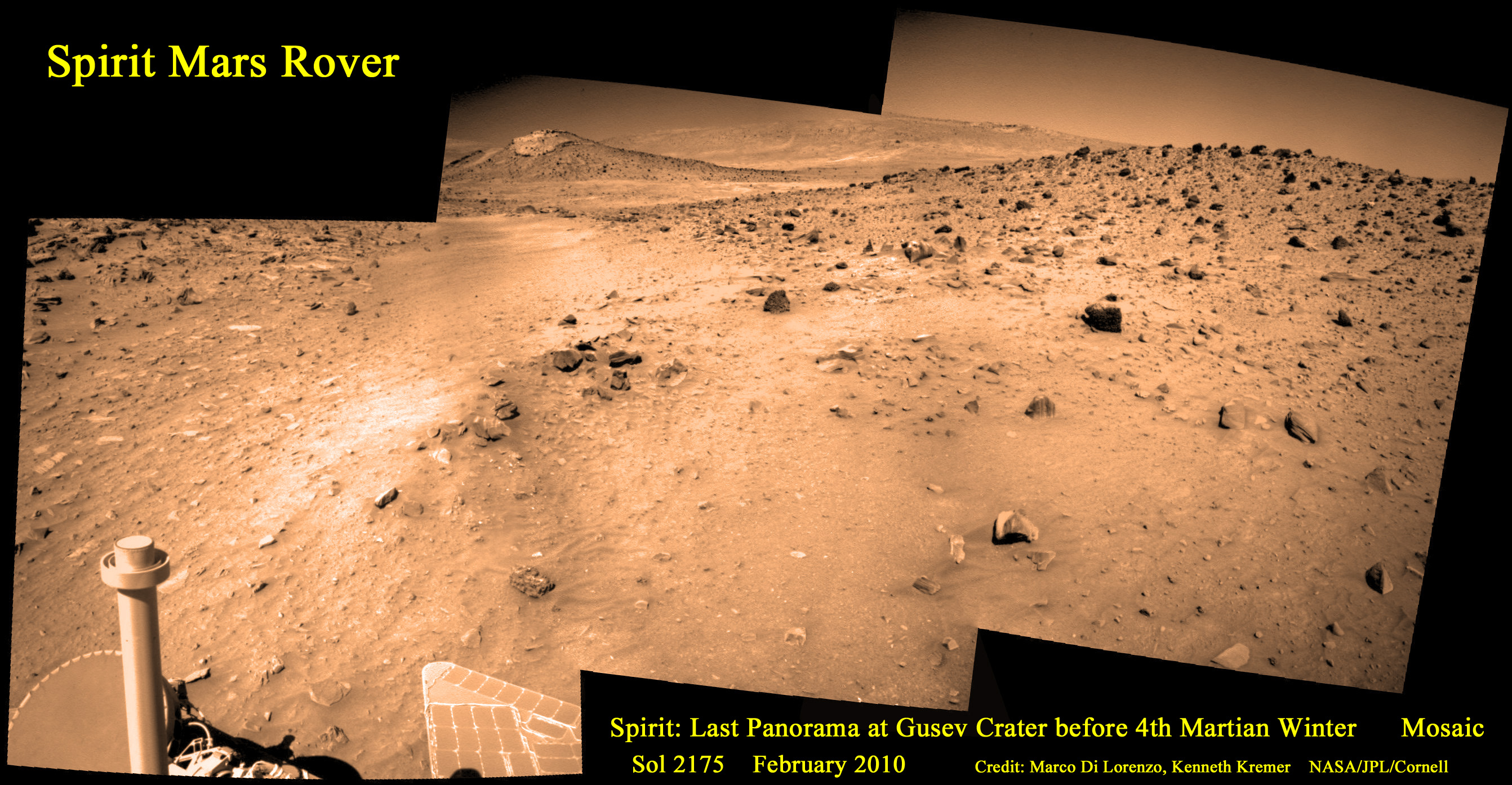
NASA announced that Spirit, that spunky little robot explorer thats been wandering around Mars for the past six years, is officially stuck and has been designated a fixed location science station. Operators are preparing it to hibernate through the long Martian winter in hopes that it can survive and continue to provide useful pictures and data for several more years.
Now, being rocket scientists, it only took them nine months to figure out that they couldn't go anywhere. I could have told them that when the bot first broke through the crust and started spinning its wheels. But I suppose I have an unfair advantage. Growing up on a farm you spend half of your time either stuck in the mud or pulling someone else out who is.
In the ongoing debate about sending men into space vs robots I generally side with sending the robots. The information return per dollar is much greater with robots than with humans. There is, however, something to be said for having a human around who can hop out, hook up a cable and come-a-long to the closest big rock, and ratchet the rover out of the sand pit when it gets mired down. A human operator on board might have avoided getting into the situation in the first place. But the original mission of Spirit was to spend three months exploring Mars. Had there been a human involved there would have been no choice but to pack up and come home before supplies ran out. And we would have missed out on almost six extra years of information that Spirit has been able to gather. The fact is that, despite 50 years of exploring and 10 years of maintaining a permanent crew aboard the International Space Station, we haven't learned to live in outer space: we just go there and camp out. We have to take everything we need with us. We can't just hang around for six extra years if we find something interesting.
If we, as humans, truly want to explore the outer solar system and beyond we should concentrate our efforts on the design and construction of a habitat capable of supporting human life outside the earth's atmosphere and independent of earth's support. Only then will we be free to explore.